
Mentorship & Leadership, Parenting & Family, Personal Development, Social Advocacy
The Anchor in the Storm: An Open Letter to Every Mother and Father Raising a Boy
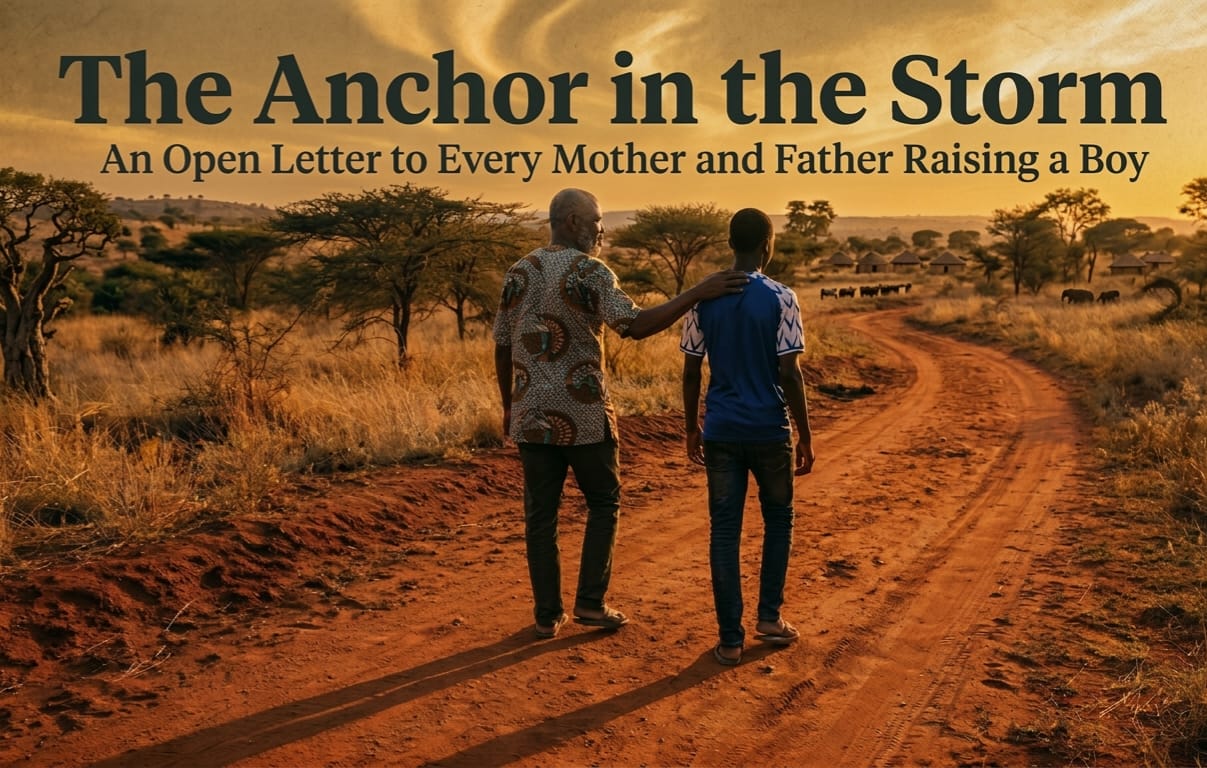
Dear Parent,
You did not sign up for this particular version of parenthood. Nobody warned you that raising a boy in this specific moment in history would require not just love and patience, but a kind of quiet, determined vigilance — the vigilance of someone who senses that the world is pulling in one direction, and that your job is to hold another standard entirely. I want to speak to that feeling directly. Furthermore, allow me to begin by saying something that I mean with complete sincerity: what you are doing matters more than you will ever fully know.
This letter seeks to connect rather than lecture. I am not here to critique your parenting or add to the overwhelming noise of advice on screen time and discipline. Instead, consider this an honest conversation between someone who works with boys every day and the parents who love them — parents who are striving, often in silence and without enough support, to raise boys into men the world will be grateful for.
“The question is not whether you love your son enough. The question is whether he can feel the shape of that love — whether it has edges and expectations as well as warmth.”
I have watched families across communities — in cities and small towns, across every background carry the same private worry. Their boy is bright. He is capable. He has a quality about him that makes people stop and notice. And yet something is slipping. Something subtle, hard to name, visible mainly in what he doesn’t say, in the way he looks at screens instead of out the window, in the gradual dimming of an ambition that once burned clearly. You see it. You lie awake wondering about it. And sometimes, in the honest privacy of your own heart, you wonder whether you are enough to meet it. You are enough. But thinking alone cannot hold a boy steady; we must move from the weight of our thoughts to the clarity of a plan.
I. Why This Moment Is Different
Every generation of parents has faced the challenge of raising children in a world that seems, in some way, to be moving too fast. But what parents of boys are navigating right now is qualitatively different from anything that came before — not in degree but in kind.
Your son is growing up in the first era of human history in which the most powerful voices shaping his identity are not people who know him. They are strangers — on platforms designed, at an engineering level, to capture his attention and hold it by feeding him content that confirms whatever his confusion is already reaching toward. If he is uncertain about his place in the world — and all adolescent boys are — those platforms will find the men who tell him that his uncertainty is someone else’s fault. They will find the voices that offer him a version of strength that requires no vulnerability, no accountability, no growth.
This influence is substantial. It is a force that cannot be countered by arguments alone, especially from a parent who has not first earned the right to be heard.
“Boys do not drift toward the wrong voices because they are broken. They drift because the right voices have gone quiet—or because the right voices have never learned how to speak in a way a boy can receive”
II. What He Is Actually Looking For
In all the years I have spent working with boys—in mentoring rooms, on sports fields, and in the difficult conversations following a crisis—I have come to believe one thing above all: boys are not looking for easy; they are looking for real.
Misbehavior is often the only reliable way a boy knows how to get a man’s full attention.
Silence is often a defense mechanism for a boy who has learned that his real thoughts produce anxiety in adults.
Wrong Belonging is simply the result of a boy who has not yet found a place in the right circles.
He is not asking to be coddled. He is not asking to be protected from difficulty. He is asking — in every act of defiance, in every moment of withdrawal, in every risk he takes that frightens you — a single question: Is there someone here who knows what I’m supposed to be growing into, and who believes I can get there?
That is the question your presence must answer. Not your perfection. Your presence. Yet, while reflection is the beginning of that presence, it must eventually lead to a clear path of action.
III. The Framework That Changes Everything
At BMAN, we have spent years distilling what actually works with boys — across cultures, across economic circumstances, across the full range of family structures — into four non-negotiable principles. We call it the L.I.V.E. framework. Not because it is a program to follow, but because it describes the conditions under which boys genuinely flourish. When all four are present, something shifts. Something in a boy relaxes and then reaches.
The L.I.V.E. Framework — What Every Boy Needs
Love — He must feel accepted before he can grow
Not love as reward for good behavior. Not love withdrawn when he disappoints. Unconditional acceptance that says: you belong here, you are wanted, and nothing you do will change that. This is the foundation. Without it, everything else is performance. A boy who feels conditionally loved will spend his entire life auditioning for approval — and he will find an audience somewhere, whether you provide one or not.
Inspire — Show him who he can become
Boys respond to vision, not instruction. They need to see concretely, specifically the kind of man they are walking toward. A man who failed and recovered. A man who chose integrity when it cost him something. A man who loved his family with discipline and devotion in equal measure. This is why mentors matter so profoundly: they are living proof that the path exists and has been walked.
Value — His effort must matter
Not his achievements. His effort. The distinction is everything. A boy who is only praised for results will either stop trying when results are uncertain, or he will lie about them. A boy whose genuine effort is noticed, named, and honored learns something more durable: that the world responds to his work, that his striving is real, and that progress — however incremental — is worth something.
Educate — Character, not only curriculum
The questions that will define the shape and quality of your son’s life will not be answered in any classroom. How do I handle failure without being destroyed by it? How do I treat people who have less power than I do? What do I owe to the people who love me? These are questions of character — and they are answered only through experience, through being held to a standard, and through the patient, repetitive work of mentorship.
IV. The Long Work of Loving a Boy Well
I want to be honest with you about something. The work I am describing is not work that shows results on any timeline a parent finds comfortable. You will say the same things many times before they land. You will hold a boundary for months before you see it internalized. You will have conversations that feel, in the moment, like they disappear entirely into the air and then, years later, your son will quote your words back to you in a moment that matters, not knowing that he is doing so.
That is how formation works. It is slow, invisible, and cumulative. It operates entirely below the surface of the daily life you can see. The father who shows up consistently and quietly — who is not the most dramatic presence in his son’s life but the most reliable one — is doing something far more consequential than he will ever know in the moment.
“The lessons you repeat today become the internal voice he carries for the rest of his life. You are not just raising a boy. You are building the man who will raise the next generation.”
Additionally, it is vital to acknowledge mothers in particular, because this letter should not speak only to fathers. The mothers raising boys especially those doing so without a consistent male partner, especially those who feel, some days, that they are building something they were not given a blueprint for — are doing one of the most demanding and underacknowledged forms of work in the world. You are not just loving your son. You are orienting him. You are giving him his first and most durable map of what it means to be cared for, to be held accountable, to be loved without conditions. That is no small thing. That is everything.
V. Why No Boy Should Walk This Alone
There is a specific kind of loneliness that belongs to adolescent boys. It is not the loneliness of isolation — many of them have friends, activities, full calendars. It is the loneliness of carrying something they cannot name, among people who they fear would not understand it if they could. The loneliness of being in the middle of becoming something, without a map, without permission to admit how much they do not know.
That loneliness is where the wrong voices find their audience. It is also where the right voices — yours, a mentor’s, a community’s have the greatest power. A boy who knows that a caring adult is paying attention to who he is becoming, and expects something of him, and will not disappear when things get hard, is a boy with an anchor. Ultimately, this ensures that an anchored boy can go into very rough water without being lost. Understanding the need is the foundation, but the structure of mentorship is what holds it together.
At BMAN, this is the work we exist to support. Not to replace you as a parent — nothing replaces a parent but to extend the circle of guidance around your son. To provide him with mentors who have walked paths he is considering, brotherhood with boys who share values of responsibility and growth, and structured challenges that demand something of him and believe something about him.
Because every boy deserves that circle. And because the world — not a distant, abstract world, but this one, right now will be shaped by the character of the boys who are growing up in it at this very moment.
With deep respect for everything you are carrying,
If this letter reached something in you, share it with another parent raising a boy. Print it. Read it again on the hard nights. And know this: the fact that you are asking these questions, the fact that you found your way to this page and read this far, already tells me something important about the kind of parent you are trying to be.
That trying is not nothing. That trying is, in the quiet accounting that matters most, everything.
Every parent of a boy should read this. Pass it on.
Ola Akinwe
Founder, Boys Mentoring Advocacy Network (BMAN)
Author · Speaker · Advocate for the Future of Masculinity
Support BMAN: Help Boys Thrive
This letter spoke to you — you can take meaningful action to support the boys we serve in communities. By contributing to BMAN, you help provide mentorship, guidance, and the resources boys need to grow into responsible, anchored men.
How you can help:
-
Donate to the Mission: Provide critical support for mentorship programs: https://goto.gg/59064
-
Become a Supporter: Monthly contributions help fund ongoing programs and give you access to webinars, discussion groups, and bonus guides.
-
Share to Inspire: Forward this letter to another parent raising a boy. Every share multiplies the impact.
Your support is not just a donation; it is an investment in the next generation of men and the future of our communities.
Ola Akinwe is the Founder of the Boys Mentoring Advocacy Network (BMAN) and a leading voice in the evolution of modern masculinity. With a background in leadership from HarvardX, Ola has dedicated his life to creating environments where young men can flourish through his proprietary L.I.V.E. Philosophy (Love, Inspire, Value, Educate).
Ola provides a map for the next generation of men. He lives and works in Lagos, Nigeria, where he continues to advocate for the anchored boy, believing that the character of our sons today will shape the world of tomorrow.

This is a testament that reality of raising boys to be come responsible men. Sir how do one handle a situation where you trying to give your son the best and trying to go all out along with him in his high and low time. But due to the fact that the son stays with the mother , who is shading him from the father getting close to him.