
Digital Well-being, Global Advocacy & Commentary, Mentorship & Leadership, Parenting & Family
The Algorithm is Raising Your Son: The Rise of the Digital Father
Editor’s Note
As traditional mentorship faces a global crisis, a new authority has filled the silence: the Digital Father. In this urgent commentary, Ola Akinwe explores the Relational Poverty driving millions of boys to seek identity through algorithms rather than human connection. It is a vital call to action for anyone committed to reclaiming the hearts and futures of the next generation of men.
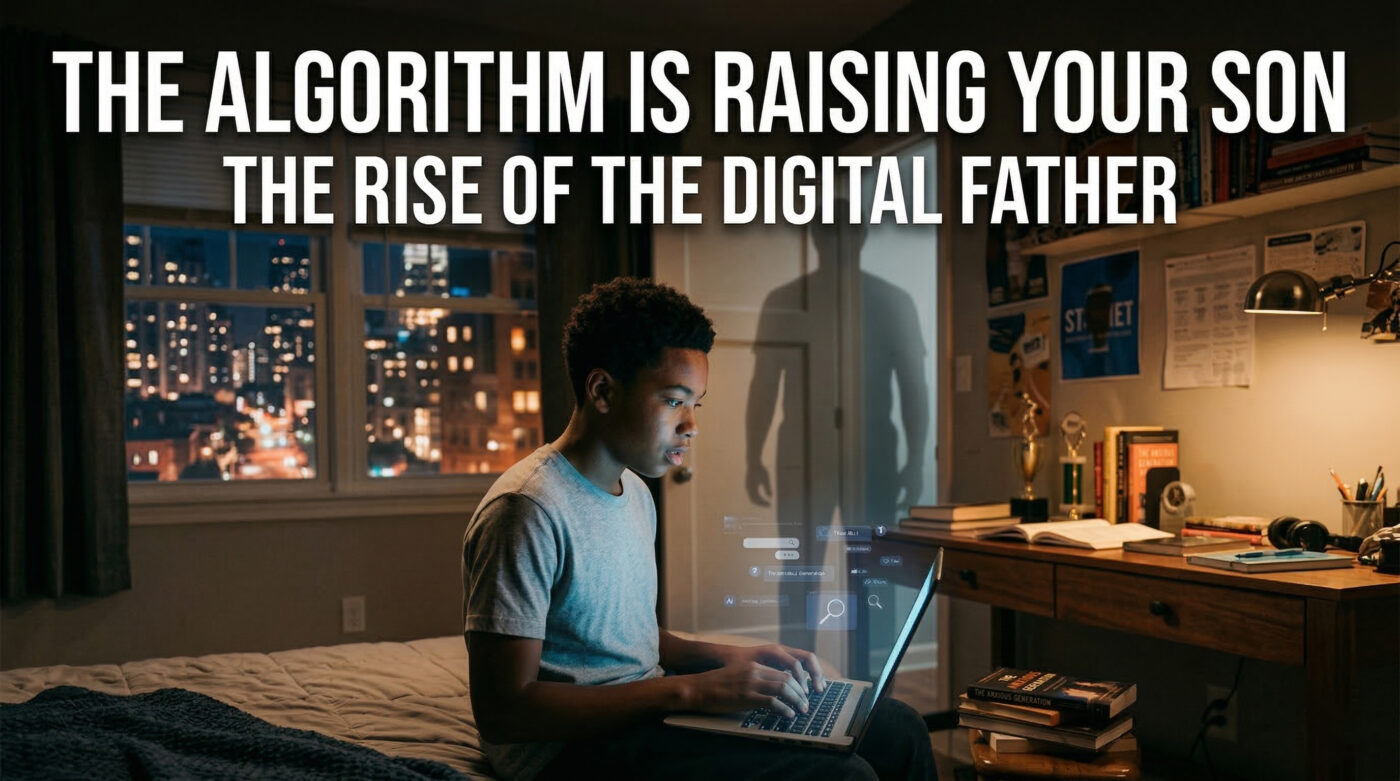
In the quiet of a teenage boy’s bedroom, a fourteen-year-old boy stares at a glowing screen. He isn’t playing a game. He is typing a question he is too ashamed to ask his father, too nervous to ask his coach, and too vulnerable to ask his friends: “How do I know if I’m a man?”
Within 0.42 seconds, an algorithm—not a mentor—answers him.
This is the dawn of the Digital Father. In a world of infinite search engines and hyper-persuasive AI, we are witnessing one of the largest social experiments in history: the outsourcing of male identity to a machine. The consequences are not just changing how boys learn; they are reshaping the very DNA of masculinity for the next generation.
The Great Relational Vacuum
A generation ago, the roadmap to manhood was handed down through the “Wisdom of the Hearth.” When a boy had a question about confidence, relationships, money, or character, he sought out a father, an uncle, or a trusted elder. These were mentors who knew his name, his temperament, and his history.
Today, that authority has been decentralized.
Boys are increasingly suffering from Relational Poverty. Even in stable homes, the crushing economic demands on fathers and the cultural “Vulnerability Gap” have created a silence. And the internet loathes a vacuum. When a father is physically absent or emotionally distant, the smartphone becomes the primary resident in a boy’s life.
“The internet has not replaced fathers. It has simply become the fastest voice in the room.”
The Alpha-Algorithm: Mentorship Without Character
Recent global studies on adolescent digital habits reveal a jarring shift: nearly 57% of young men now identify social media influencers as their primary source of life advice, often valuing their guidance above that of teachers or local mentors. For a boy navigating the storms of adolescence, these tools feel like mentors who never sleep and never judge. But there is a dark trade-off.
The Alpha-Algorithm is not a single person, but a curated pipeline designed to capture a boy’s natural desire for agency and redirect it toward a narrow, often toxic, definition of power.
Consider a typical digital journey: A boy searches for “how to be confident” to deal with a school bully. The algorithm provides a helpful tip on body language. But then, it “upsells” him. Within three clicks, he is served content on “frame control,” then “financial dominance,” and finally, the “commodification of women” as a metric of success. This is the pipeline: it takes a healthy desire for self-improvement and converts it into a worldview built on dominance.
The Digital Father offers answers without accountability. It provides “hacks” for life without the hard work of building character. It gives a boy a script to follow, but it can never give him a blessing
The Quiet Transfer of Authority
We are seeing a profound shift in where credibility lives. In the digital ecosystem, authority is measured by visibility, not responsibility.
A teenage boy today may quote an anonymous podcaster or a viral influencer with more conviction than he quotes his own father. Why? Because the influencer is curated, polished, and always available. The Digital Father doesn’t have a bad day, doesn’t get tired after a 10-hour shift, and doesn’t demand that you clean your room before giving you advice.
“The result is a generation of boys who know everything about the world, but nothing about how to live in it.”
When Technology Fills the Silence
We must be clear: technology is not the villain; it is the mirror. The digital world is not a monolith of toxicity; many boys find refuge in hobbyist communities, creative outlets, or mental health forums. However, these quiet spaces are often drowned out by the sheer volume of the Alpha-Algorithm, which is optimized for outrage and dominance rather than character and care.
The rise of the Digital Father is a cultural signal—a siren blaring in the heart of our communities. Boys have not stopped searching for guidance. If anything, they are searching more urgently than ever. But an algorithm cannot nurture a soul. It cannot look a boy in the eye and say, “I am proud of you.”
The real issue is not the screen; it is the relational vacuum that the screen fills. If we want to reclaim the hearts of our sons, we must out-pace the algorithm with our presence.
Why This Conversation Matters Now
If we wish to understand the future of leadership, we must look at who is teaching our boys today. We cannot afford to leave the formation of young men to the highest bidder in the attention economy.
Organizations like the Boys Mentoring Advocacy Network (BMAN) are standing in this gap. By championing the return of physical mentorship and global advocacy, BMAN is asking the essential question: If boys are learning how to become men somewhere, who—or what—is doing the teaching?
The answer will determine more than just the trajectory of one generation. It will determine the health of our future society.
Support the Return to Presence
The Digital Father is winning because he is always there. To compete, we must empower the “Human Father” and the community mentor.
Your support for BMAN is an investment in presence over pixels. We are committed to providing direct mentorship, parental resources to bridge the Vulnerability Gap, and global advocacy to shift the narrative of masculinity from dominance to purpose.
“The algorithm can give a boy an answer. Only a mentor can give him a future.”
Support BMAN Now →Give a Boy a Real Future
Ola Akinwe is the founder of the Boys Mentoring Advocacy Network (BMAN) and the creator of the L.I.V.E Operating System. A global advocate and author, he is dedicated to bridging the mentorship gap and developing character-driven frameworks for the next generation of men.
- Key References
- Common Sense Media (2025): Boys in the Digital Wild: Online Culture, Identity, and Well-Being. Link
- Mental Health America (2025): Breaking the Algorithm: Redesigning social media for youth well-being. Link
- American Institute for Boys and Men (2025): Boys & Men Online Research Program. Link
- Equimundo (2023): State of the World’s Fathers: Centering care in a world in crisis. Link

A lot of human fathers that are not present either physically or emotionally attribute this to needing to provide for these boys……empowering these men helps regulate their nervous systems which aids connection with both themselves and their boys.