
Boys Education & Development
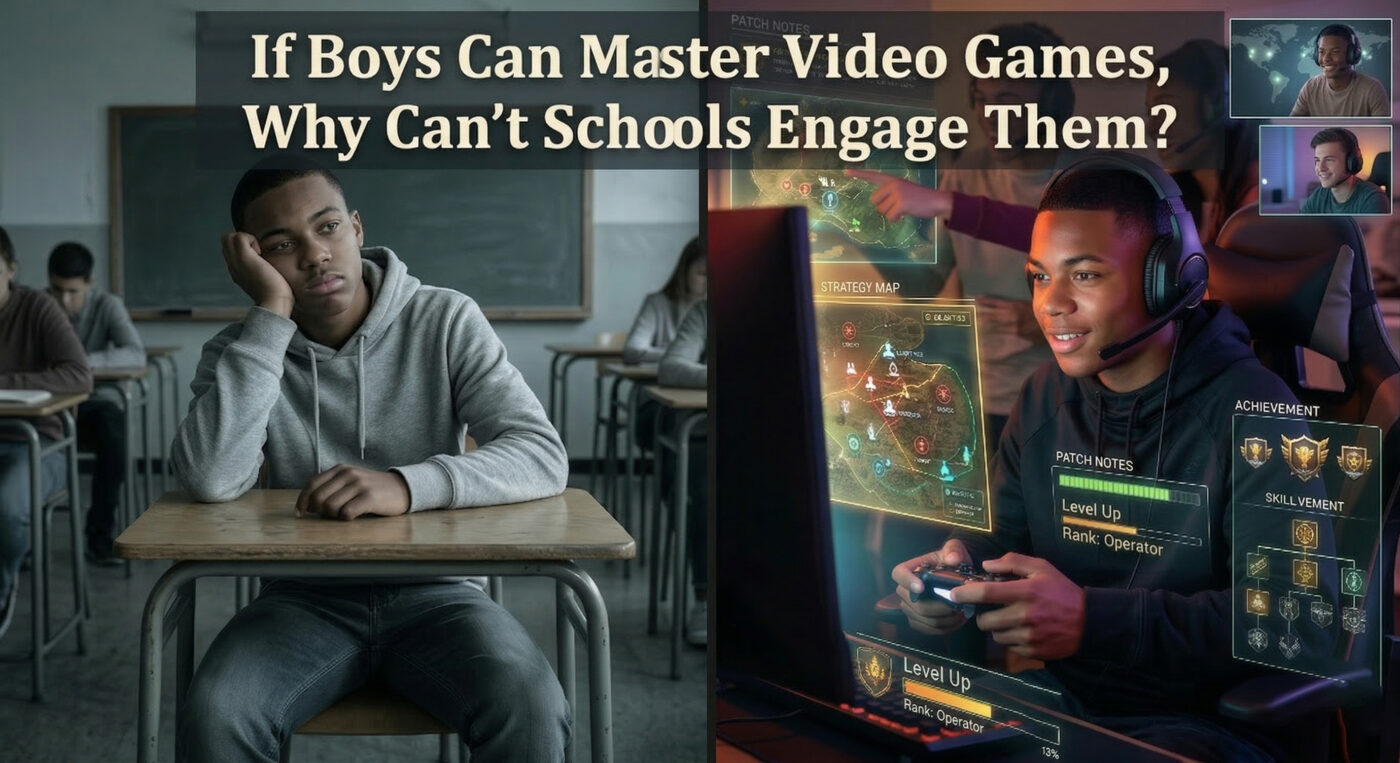
If Boys Can Master Video Games, Why Can’t Schools Engage Them?
What Global Research Reveals About Young Men, Motivation, and the Future of Education
Editor’s Note
This essay explores a growing global concern: the widening engagement gap between boys and formal education. Drawing on international research and more than a decade of field experience mentoring boys, BMAN Founder Ola Akinwe examines why young men thrive in game environments yet disengage in traditional classrooms—and what educators, parents, and policymakers can learn from it.
Think of a student who cannot sit still in class. His teacher sends notes home about distraction, disconnection, and disrupted lessons. His parents find themselves trapped in an exhausting cycle of reminders, consequences, and unfinished homework. He stares at his desk as if it were a prison cell.
Now, watch what happens when he returns home, drops his bag, and picks up a controller. Suddenly, hours disappear. He studies complex maps, analyzes technical patch notes, and coordinates intricate strategies with teammates across three time zones. He may fail a level thirty times, yet he returns for the thirty-first attempt without a second thought.
The word “quit” never enters his mind. This child is not broken, nor is he lazy. This striking contradiction—where the same individual who cannot focus in a classroom for forty minutes can commit to a digital world for six hours—is one of the most important and overlooked questions in education today.
The issue isn’t a lack of capability; it is a failure to design environments worthy of that potential.
In many developed nations, boys now make up nearly two-thirds of the lowest academic performers, while girls increasingly dominate university enrollment. What appears to be a classroom management problem is, in reality, part of a much larger global shift in how young men experience education.
A Universal Pattern: This Is Happening Everywhere
What makes this challenge so urgent is that it isn’t an isolated incident or a localized story. This narrative extends far beyond economic status or cultural boundaries. The reality of young men pulling away from their education is a universal phenomenon documented by the world’s most rigorous research institutions.
The Organization for Economic Co-operation and Development (OECD), which tracks outcomes across dozens of countries, has consistently found that male learners report lower levels of classroom commitment and academic drive than their female peers. This isn’t a regional glitch, but a consistent international trend.
Research from the American Psychological Association highlights a different, equally troubling insight: adolescent males check out most sharply when the link between their studies and their eventual adulthood feels tenuous. The hurdle isn’t the difficulty of the curriculum, it is the perceived futility of it.
Furthermore, the Brookings Institution has noted that this demographic experiences higher rates of disciplinary action and lower academic persistence worldwide. Meanwhile, global education data from UNESCO shows that in many regions, young men are more likely to abandon their schooling entirely. In almost every instance, emotional withdrawal is the first domino to fall. It is the warning sign we keep overlooking.
The Design Gap: Games Instruct. Schools Evaluate.
There is an enigma educators rarely investigate: Why can a digital landscape hold a student’s focus for six hours while a classroom struggles to maintain it for twenty minutes? While many point to addiction as the culprit, the underlying truth is found in the architecture of the game itself.
The most successful games are built around a sophisticated framework of motivation. The moment a player enters, the mission is clear. Every action triggers immediate feedback. Growth is tangible, allowing you to see your rank, your stats, and your evolving mastery in real time.
The goal is not to turn schools into entertainment platforms. It is to learn from environments that sustain deep engagement and apply those principles to education with wisdom and restraint.
In these environments, setbacks are not met with shame; instead, they become data points. Each “Game Over” reveals exactly what must be adjusted to advance. These hurdles are carefully calibrated to sit at the edge of a player’s current capability, making them demanding enough to require focus, but achievable enough to reward grit. Psychologists call this “flow,” and games engineer it by design.
While games succeed because they make engagement immediate and visible, education’s purpose extends beyond instant gratification. Schools are tasked with building discipline, critical thinking, civic responsibility, and long-term mastery—skills that often require delayed rewards and tolerance for challenge or boredom. By understanding how motivation works in high-engagement environments, educators can design experiences that respect the serious purpose of schooling while making learning meaningful, goal-oriented, and intrinsically rewarding for young men.
Traditional schooling often functions as the inverse. Results arrive weeks after the effort is spent. Growth is measured against static benchmarks rather than personal evolution. Struggles are recorded, averaged, and permanently filed. For many young men, the most motivating impulse in human psychology—the question of what they are building toward—is met with something abstract: a grade point average, a diploma, or a career path that feels light-years away. They do not lose interest because they lack focus; they detach because they are starving for a sense of mission.
The Deeper Hunger: Identity and Kinship
Adolescence is more than a window for absorbing curriculum; it is the most volatile and vital phase of self-definition in a human life. Young men are grappling with internal inquiries they may not yet have the vocabulary to voice: Who am I becoming? What is my contribution? Where do I belong? Who truly sees me?
When schools fail to provide clear avenues for leadership and recognition, male learners do not just remain idle with those uncertainties. They go hunting for answers elsewhere. Sometimes that search leads toward healthy mentorship, but it can just as easily veer toward more destructive influences. A vacuum of kinship is never neutral; adolescents will find a tribe wherever one exists.
One element educational institutions consistently undervalue is the sheer force of peer-driven connection. The urge to belong to a crew, a team, or a shared mission is not a distraction from growth; it is the primary engine of it. Students embedded in positive, collective environments exhibit sharper resilience and superior long-term outcomes.
Within the male experience, brotherhood is not a luxury, but the very foundation of development.
When educators and mentors intentionally design spaces that foster identity, purpose, and kinship, they create environments where young men are not just present—they are fully engaged, resilient, and ready to contribute meaningfully to society.
An Architecture for Evolution: The L.I.V.E. Framework
Drawing on over a decade of direct experience working with boys, I developed a universal methodology designed to address these psychological realities: the L.I.V.E. Principles. Rather than leaning on traditional lectures or punitive measures, this model functions as a behavioral development ecosystem.
The L.I.V.E. principles serve as the four pillars:
- Love: Establishing deep belonging and psychological safety.
- Inspire: Illuminating a compelling, high-stakes future.
- Value: Validating tangible, visible milestones.
- Educate: Cultivating discipline and a legacy of leadership.
Within this structured trajectory, learners advance through clearly defined tiers:
- Agent: Mastering the art of personal discipline.
- Operator: Refining the skills of teamwork and collective impact.
- Architect: Mentoring the next generation and serving the community.
The result is a transparent trajectory of maturity. Young men understand exactly where they stand, where they are headed, and the precise level of grit required to reach the next stage. The same mechanics that make gaming irresistible are here redirected toward a more profound end: the forging of character.
The Choice Before Us
The drift of young men away from the classroom is not a mystery, and the data is undeniable. What we lack is not information, but boldness. Somewhere right now, a student is staring past his teacher and out the window. It is not because his mind is failing; it is because he has not yet been assigned a mission worthy of his fire.
The future architects of our families and institutions are currently occupying those desks. The core dilemma is not their capability. It is whether we are courageous enough to overhaul the environments surrounding them before we lose them to the margins.
The real competition for the attention of young men is not between homework and video games. It is between systems that give them a mission and systems that do not.
When young men are given structure, a sense of mission, and a band of brothers, they do not check out.
They rise.
Low Income Families Education (L.I.F.E) Support Fund
Every year, many children are forced out of school simply because their families cannot afford the fees. The L.I.F.E Support Fund provides emergency education support for students—especially those from single-parent homes—so financial hardship does not destroy their future.
No child should lose their future because of unpaid school fees.
Support the Mission: Help keep a student in school today.
Ola Akinwe is the Founder of the Boys Mentoring Advocacy Network (BMAN) and creator of the L.I.V.E. framework, a mentorship system that guides boys toward purpose, leadership, and resilience. With expertise in Leadership (HarvardX), Instructional Design (University System of Maryland), and Psychology (KU Leuven), he builds programs that help young men thrive academically, socially, and personally.
