
Boyhood, Press Room
The Boy Crisis Nobody Is Talking About And Why It Matters for the Future
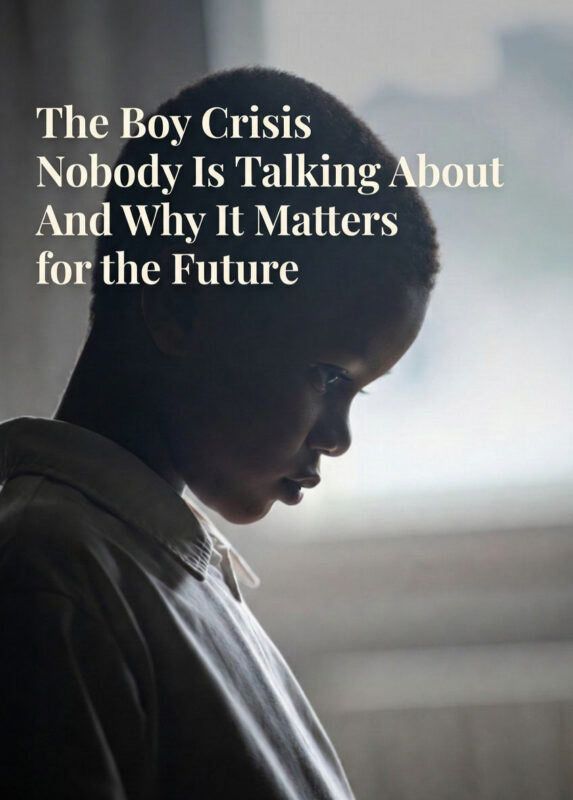
Picture a boy, around twelve years old. He is bright, curious, full of energy. Then something shifts. Gradually, the spark dims. He becomes quieter. His grades slip. He stops showing up — first to school events, then to family conversations, and eventually to life itself. His parents notice. His teachers notice. But no one quite knows what to say.
This scene is not a rare exception. It is playing out in homes, classrooms, and communities across the world, at a scale we are only beginning to understand. And while the symptoms are visible, the root cause remains largely undiagnosed.
Boys don’t need to be fixed. They need to be guided — and the difference between those two ideas is everything.”
This is not a crisis of intelligence, character, or potential. It is a crisis of architecture — of the systems and structures that societies have historically relied upon to guide boys into responsible manhood. Those systems are breaking down. And in their absence, a generation of young men is adrift.
The Numbers Tell a Sobering Story
Before we can solve a problem, we must be willing to see it clearly. The data on boys and young men in the modern world paints a picture that should concern every parent, educator, and community leader:
3× boys are diagnosed with ADHD for every 1 girl- reflecting a school environment poorly suited to male development patterns
60% of college graduates in the US are now women- a 20-point reversal from fifty years ago
1 in 3 of young men aged 18–34 report feeling purposeless- according to recent social wellbeing surveys
15M+ of boys in the US grow up without a consistent male mentor- leaving them to navigate adolescence without guidance
These numbers are not an indictment of boys. They are an indictment of the environments we have built — or failed to build — for them. The question is not whether boys are capable. History provides an overwhelming answer to that. The question is whether we are giving them what they need to thrive.
When the Pathways Disappeared
For most of human history, the transition from boyhood to manhood was not left to chance. Every major civilization from the Maasai of East Africa to the Indigenous nations of North America, from ancient Greece to feudal Japan had formalized systems for bringing boys into responsible adulthood.
These systems varied enormously in their rituals and customs. But beneath their cultural differences, they shared a common architecture built on four pillars:
- Mentorship from respected older men who modeled what maturity looked like.
- Rites of passage that marked clear transitions and conferred earned status.
- Real responsibility within the community — work that mattered and was seen to matter.
- A clear moral code that defined what it meant to be a good man.
Through these systems, boys did not simply age into manhood. They earned it, step by step, through demonstrated character and contribution. The community bore witness. The transition was real and visible.
Over the past century, industrialization, urbanization, the fragmentation of extended families, and the weakening of civic institutions have dismantled most of these structures. The rituals faded. The mentors dispersed. The rites of passage were replaced by birthday cakes and driver’s licenses. But the developmental needs of boys — the deep hunger for challenge, recognition, belonging, and purpose did not go away. They went underground.
Why Boys Retreat Into Digital Worlds
If you want to understand where many boys are finding what they need, look at where they are spending their time. The average young man between the ages of fifteen and twenty-four in the developed world now spends more hours each week playing video games or consuming online content than he spends in any other single activity outside of sleep.
The instinct of most adults is to see this as the problem. But that is the wrong diagnosis. The games are not the disease. They are a symptom — and if we look closely at what they are actually offering, we find something instructive.
“When real life lacks structure, boys build their own. The only question is what they build it from.”
The most successful games and online platforms share a remarkably consistent design philosophy. They offer:
- A clear mission — an explicit purpose the player is working toward.
- Visible progress — a leveling system that makes growth tangible and measurable.
- Mastery challenges — difficulty that scales with ability, rewarding effort.
- Team belonging — a squad, a guild, a crew that needs you.
- Earned recognition — achievements, titles, and respect from peers.
This is not a list of entertainment features. It is a list of the exact psychological needs that traditional male developmental systems were designed to meet. Boys are not retreating into games because they are lazy or broken. They are going where their needs are being met because nowhere else is meeting them.
The solution is not to take the games away. It is to build real-world environments that offer the same architecture with stakes that actually matter.
The L.I.V.E Framework: A New Architecture for Boyhood
The Boys Mentoring Advocacy Network was built on a single conviction that the developmental crisis facing boys today is not inevitable. It is the product of broken systems and systems can be redesigned.
After years of working with boys, families, and communities, I developed the L.I.V.E System Upgrade for Boys: a mentoring framework built around four foundational principles that, together, create the structured pathway boys need. L · I · V · E (Love, Inspire, Value, Educate)
Love: The Foundation of Trust
Boys cannot be guided by people they do not trust. Love, in this context, is not sentimentality — it is radical commitment: the willingness to show up consistently, to hold high standards, and to believe in a boy’s potential even when he has stopped believing in it himself. Love is what makes mentorship safe enough to be honest.
Inspire: Igniting the Flame of Purpose
Purpose is not discovered passively. It is awakened through exposure to what is possible through stories of men who struggled and built something meaningful, through challenges that stretch capacity, through the experience of contributing to something larger than oneself. Inspiration is the fuel that drives boys toward becoming.
Value: Making Contribution Visible
One of the deepest needs of any developing boy is to be seen — not merely tolerated but genuinely valued for what he brings. The L.I.V.E framework creates deliberate structures for recognition: not empty praise, but the acknowledgment of real effort, real growth, and real contribution.
Educate: Equipping for Life
Education here goes far beyond academic content. It encompasses emotional intelligence, financial literacy, conflict resolution, leadership skills, and the habits of disciplined character. The goal is not test scores. It is the formation of men who are equipped to navigate a complex world with wisdom and integrity.
The Three Stages of the Leadership Pathway
At the heart of the L.I.V.E System Upgrade for Boys is a progressive developmental pathway — a structured journey through three stages that mirror the arc of genuine maturity. Each stage has its own expectations, challenges, and recognitions. Boys know where they are. They can see where they are going. And they understand what it takes to advance.

Stage One: AGENT — Building the Inner Foundation
At this stage, the work is deeply personal. Boys focus on developing self-discipline, building consistent habits, and learning to take genuine accountability for their choices. They are not yet leading others — they are learning to lead themselves. The Agent stage establishes the interior architecture that everything else will rest upon.

Stage Two: OPERATOR — Expanding to Others
Having built personal discipline, the boy now turns outward. The Operator stage focuses on teamwork, communication, and leadership within a group context. Boys take on real responsibilities within the program community, exercise influence, and experience the weight of being depended upon. This is where character is stress-tested.

Stage Three: ARCHITECT — Shaping the Future
The highest stage transforms a boy into a builder. Architects mentor younger members of the community, contribute to the design of initiatives, and begin to shape the culture around them. This is the stage where young men discover that their greatest purpose is not personal achievement but the development of others.
The power of this architecture is not complexity — it is clarity. Boys always know where they stand, what is expected, and what they are working toward. In a world drowning in ambiguity, that clarity is transformative.
The Role of Families: Parents as Partners
No mentoring program, however well designed, can substitute for the family. Parents — both mothers and fathers are the primary architects of a boy’s identity. They shape his earliest understanding of what love looks like, what responsibility means, and what kind of man he is becoming.
Yet many parents today find themselves navigating their son’s adolescence without a map. The boy they knew at ten has become someone they struggle to reach at fifteen. The distance grows. Conversations become arguments. Connection frays.
Much of this friction is developmental, not personal. Understanding the specific psychological changes that boys undergo during adolescence — the surge toward autonomy, the testing of authority, the desperate need for respect can transform how parents engage with their sons. The shift from managing a child to guiding an emerging man changes everything about the relationship.
“The boys who thrive are not the ones with the most resources. They are the ones with the most consistent adults in their corner.”
The L.I.V.E System actively partners with families, offering parents frameworks for understanding their sons and tools for maintaining connection through the often turbulent years of adolescence. When families and mentors work in alignment, the results are remarkable.
Why This Is Bigger Than One Boy
It would be easy to read this article as a conversation about individual boys and their individual challenges. But the implications reach much further.
Every community depends upon the character and contribution of the men within it. Men who are grounded in purpose and responsibility become fathers who are present, employers who are fair, neighbors who show up, and leaders who can be trusted. Men who grew up without guidance and structure too often perpetuate cycles of disconnection, absent fatherhood, and misdirected energy.
This is not a condemnation. It is a recognition of cause and effect. When we invest in the development of boys, we are investing in the health of every family, neighborhood, and institution that those boys will one day inhabit and lead.
The return on that investment is enormous. The cost of neglect — measured in prison populations, broken families, lost productivity, and communities without capable leadership — is greater still.
What You Can Do Right Now
Reading this article is a beginning. The next step depends on who you are.
If you are a parent
Pay attention to whether your son has a clear sense of direction and belonging. Ask not just ‘How was school?’ but ‘What are you proud of this week?’ and ‘Who do you want to become?’ Consider connecting him with a structured mentoring environment.
If you are an educator or youth worker
Look at your programming through the lens of male developmental needs. Does it offer challenge, visible progress, genuine responsibility, and peer belonging? If not, it may be reaching girls well but failing boys.
If you are a community leader or philanthropist
Invest in programs that offer structured, sustained, relationship-based mentoring for boys. Not one-off workshops. Not passive after-school holding environments. Programs with architecture, progression, and high expectations.
If you are a man who had mentors
You are sitting on one of the most valuable resources in your community — your own experience and presence. The boys around you need what you have. The question is whether you are willing to give it.
The Question Before Us
There is no shortage of capable, hungry, purpose-driven boys in the world. There is a shortage of systems that channel their energy toward something worthy.
The L.I.V.E System Upgrade for Boys is one answer to that shortage. It is not the only answer. But it is a proven, principled, and urgently needed response to a crisis that has gone unspoken for too long.
History is clear on one point: when you give boys a worthy challenge and a clear path, they will surprise you every time. Not because they were fixed. Because they were trusted.
“The future of our communities is not written yet. It is being written right now — in the choices we make about which boys we will show up for, and how.”
Ola Akinwe is the Architect of the L.I.V.E. System and Founder of Boys Mentoring Advocacy Network (BMAN). His work focuses on decoding and rebuilding the modern African male development framework.
He operates from a unique Triad of Authority that combines Leadership (HarvardX), Instructional Design (University System of Maryland), and Psychology (KU Leuven) to design practical systems for guiding boys into responsible manhood.
Unlike traditional motivational speakers, Ola builds systems.
He is the author of the L.I.V.E. Trilogy and leads structured mentorship programs designed to address the growing challenges facing boys and young men.
His work is backed by an official operational license from the Lagos State Ministry of Youth and Social Development, supporting his mission to correct the developmental “glitch” affecting modern boys and install the character, discipline, and responsibility required for manhood.
Mission:
To transform boys into purposeful men through structured mentorship and behavioral architecture.
