
Boyhood, Press Room
THE BOYS NOBODY MARCHED FOR
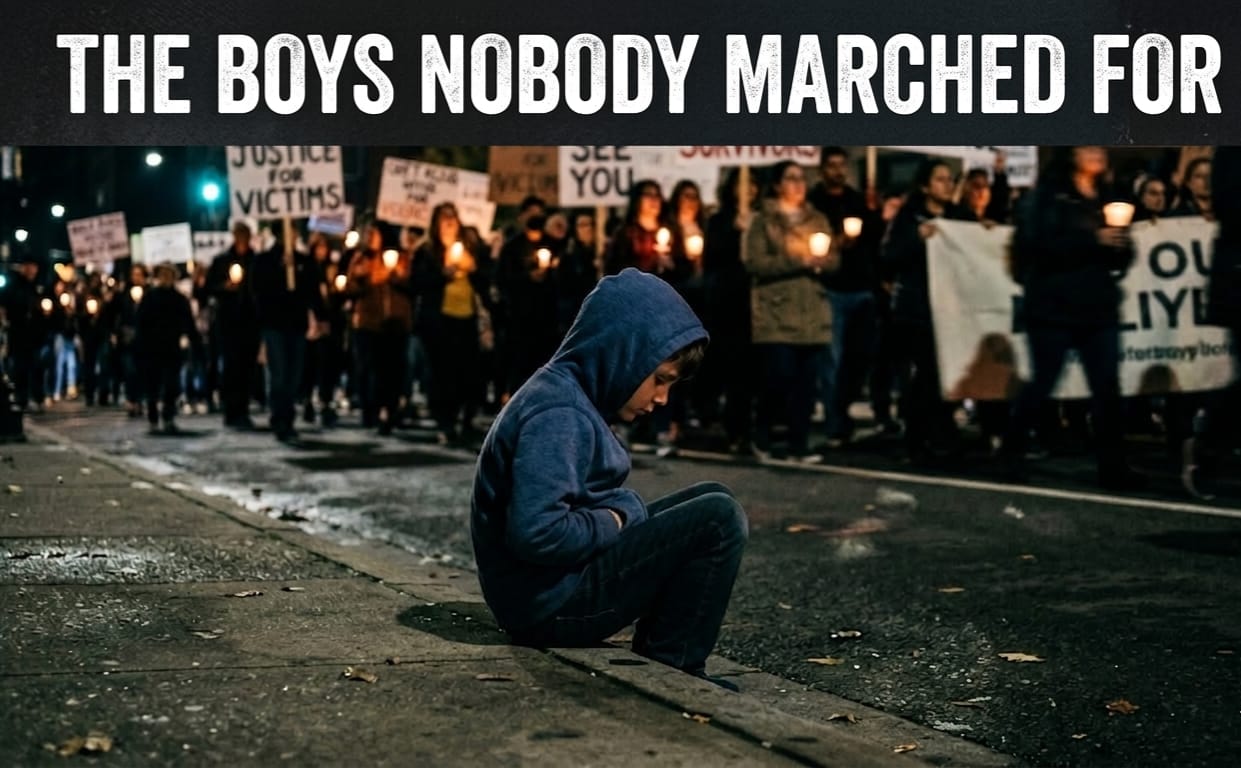
While the world rallies for victims it can see, countless boys suffer unseen. Their stories have been overlooked until now.
The Silence Around an Overlooked Reality
When a girl is sexually assaulted, the world responds with urgency and moral clarity. Headlines appear across major news outlets, social media fills with hashtags demanding justice, and communities gather for candlelight vigils in solidarity with the victim. Advocacy groups mobilize resources, policymakers demand accountability, and the public conversation centers on the need to protect the vulnerable. These responses reflect a deeply important moral instinct: when a child is harmed, society must not remain indifferent.
Yet when a boy is sexually abused, the response is often very different. The conversation grows uncomfortable. Doubt creeps in. The subject is quietly redirected or dismissed altogether. In some cases, the reaction is not outrage but disbelief, or even ridicule. The cultural narrative surrounding masculinity has made it profoundly difficult for many societies to accept that boys can be victims of sexual violence. As a result, one of the most serious forms of childhood trauma remains largely invisible in public discourse.
“Boys are not safer victims. They are simply quieter victims.”
The silence surrounding male sexual abuse is not the result of a lack of evidence or a lack of suffering. It is the result of a cultural blind spot—one that has allowed countless boys to carry their pain alone.
The Statistic Few People Want to Confront
Research conducted across multiple countries consistently suggests that approximately one in six men experienced some form of sexual abuse before the age of eighteen. This is not a rare or isolated phenomenon. It means that in almost every classroom, sports team, youth group, and neighborhood, there are boys who have endured experiences they never fully disclosed or were never believed when they tried.
Despite the scale of this reality, male childhood sexual abuse rarely receives the same sustained public attention as other forms of victimization. Awareness campaigns remain limited, large-scale advocacy movements are rare, and media narratives seldom center boys as survivors. For many boys, the message is subtle but unmistakable: their suffering does not fit the story society expects to hear.
What Happens to a Boy Nobody Believes
Trauma that cannot be acknowledged rarely disappears. Instead, it becomes internalized and reshapes the way a person experiences the world. A boy who experiences abuse and receives no meaningful recognition or support often learns to bury the experience beneath layers of emotional self-protection. Silence becomes a coping strategy.
Over time, that silence can shape the trajectory of a life. Unprocessed trauma may surface in forms that others struggle to interpret—anger, emotional withdrawal, compulsive sexual behavior, substance abuse, or an enduring difficulty forming trusting relationships. These patterns are frequently interpreted as character flaws rather than as signals of unresolved pain.
“A boy who cannot speak about his wound may spend a lifetime trying to hide it.”
The Language of Distress: A How-To for Gatekeepers
A boy’s pain often does not arrive in words—it arrives in behavior. Sudden aggression toward siblings or peers, regression in previously mastered habits, hyper-vigilance, or an uncharacteristic withdrawal from activities he once loved may all signal that something is deeply wrong. Recognizing these signs is not about blame; it is about awareness. It gives parents, teachers, and mentors the language to start a conversation, ask the right questions, and create a safe space where a boy can begin to tell his story. Small interventions tonight—listening without judgment, offering consistent presence—can prevent decades of hidden suffering.
Why Predators Exploit the Silence
Those who prey on children are often disturbingly aware of the cultural silence surrounding male victimization. Boys are statistically less likely to report abuse and historically less likely to be believed when they do. The same expectations that encourage boys to appear strong and self-reliant can make them uniquely vulnerable when they are harmed.
Shame, confusion, and fear of ridicule create powerful barriers to disclosure. A boy who believes that revealing abuse will bring humiliation rather than protection may choose silence as the safest available option.
“Silence does not protect boys. It protects the people who hurt them.”
The Cultural Script Boys Grow Up With
Part of the challenge lies in the expectations placed on boys from an early age. Across many cultures, boys grow up absorbing the message that emotional vulnerability is incompatible with masculinity. They are encouraged to endure pain quietly, to suppress fear, and to demonstrate resilience regardless of what they are experiencing internally.
Resilience is a valuable trait, but when it is misinterpreted as emotional silence, it can become dangerous. Boys who have never been taught how to articulate distress may struggle to explain experiences that have deeply affected them.
“When pain has no language, it eventually finds expression in behavior.”
L.I.V.E. and E.V.I.L.: From Trauma to Potential
Unprocessed trauma doesn’t vanish when a boy grows into a man. The very lessons that silenced him—“man up,” “don’t feel”—can later manifest in ways that harm himself or others. This is where the L.I.V.E. framework becomes essential: it provides a roadmap for both diagnosing and addressing the hidden impact of trauma.
L.I.V.E. – Love, Inspire, Value, Educate – represents the pillars of healthy development:
- Love: Safe attachment and emotional connection
- Inspire: Purpose, mentorship, and motivation
- Value: Self-worth and respect for others
- Educate: Emotional literacy, problem-solving, and coping skills
When trauma blocks these pillars, E.V.I.L. – Exploitation, Vilification, Inhibition, Loathing – emerges:
- Exploitation: Using others to compensate for unmet needs
- Vilification: Blaming or dehumanizing others
- Inhibition: Emotional withdrawal or suppression
- Loathing: Self-hate or destructive behaviors
Diagnosis and Solutions:
By observing E.V.I.L. behaviors in boys, mentors and caregivers can map these behaviors back to the L.I.V.E. pillars and identify which areas of development were blocked by trauma. Interventions can then restore each pillar:
- Love: Mentorship, safe relationships, and trust-building
- Inspire: Encouraging goals, modeling purpose, and celebrating achievement
- Value: Affirming worth, teaching empathy, and validating experiences
- Educate: Emotional literacy, coping strategies, and guided reflection
“Addressing a boy’s trauma today is not just about healing him; it is about unlocking his potential for leadership, empathy, and resilience tomorrow.”
The Long Shadow of Unspoken Trauma
Unprocessed trauma rarely remains confined to childhood. Instead, it casts a long shadow across adult life. A boy who never received acknowledgment or support may grow into a man who struggles to trust others, regulate emotions, or maintain stable relationships. These struggles ripple outward into marriages, parenting, workplaces, and communities.
Neutrality Is Not Neutral
The absence of conversation about male sexual abuse is sometimes framed as neutrality. In reality, silence carries consequences. When societies fail to acknowledge a group of victims, they implicitly communicate that those experiences fall outside the boundaries of collective concern.
Ignoring a problem does not reduce its impact; it simply delays the moment when its consequences become visible elsewhere. Many of the emotional struggles that emerge later in life are rooted in wounds that were never given the chance to heal.
To the Boys Nobody Marched For
For the many boys who experienced abuse and were never believed, one truth deserves to be spoken clearly: what happened to you mattered. Your silence was not weakness. In many cases, it was a survival strategy in an environment where vulnerability carried enormous social risk.
Healing begins when those experiences are acknowledged rather than dismissed. Every survivor deserves the opportunity to understand what happened and to rebuild a sense of safety and dignity.
The Call to Community
The boys nobody marched for deserve more than awareness—they deserve action. Start marching today in your home, classroom, or community. Support initiatives like BMAN, advocate for school policies that recognize boys’ vulnerabilities, and normalize conversations about emotional safety and consent. Collective advocacy transforms silence into protection, indifference into vigilance, and private pain into public accountability. Every step, no matter how small, contributes to a world where boys can grow, heal, and thrive without having to hide their wounds.
The Boys Nobody Marched For
History often celebrates the movements that rallied in defense of victims. It is less comfortable remembering the victims who remained unseen.
“A society that cannot see wounded boys will eventually struggle to understand wounded men.”
The boys nobody marched for are still here. Their stories did not disappear simply because the world looked away. It is time to see them. And it is time to start marching.
Ola Akinwe is the Architect of the L.I.V.E. System and the Founder of the Boys Mentoring Advocacy Network (BMAN), a movement dedicated to strengthening the emotional, psychological, and social development of boys and young men across Africa and beyond.
