
Digital Father, Digital Well-being, GlobalBoysConversation, Mentorship & Leadership, Parenting & Family, Social Advocacy
Beyond the Algorithm: Reclaiming the Human OS from the Digital Father
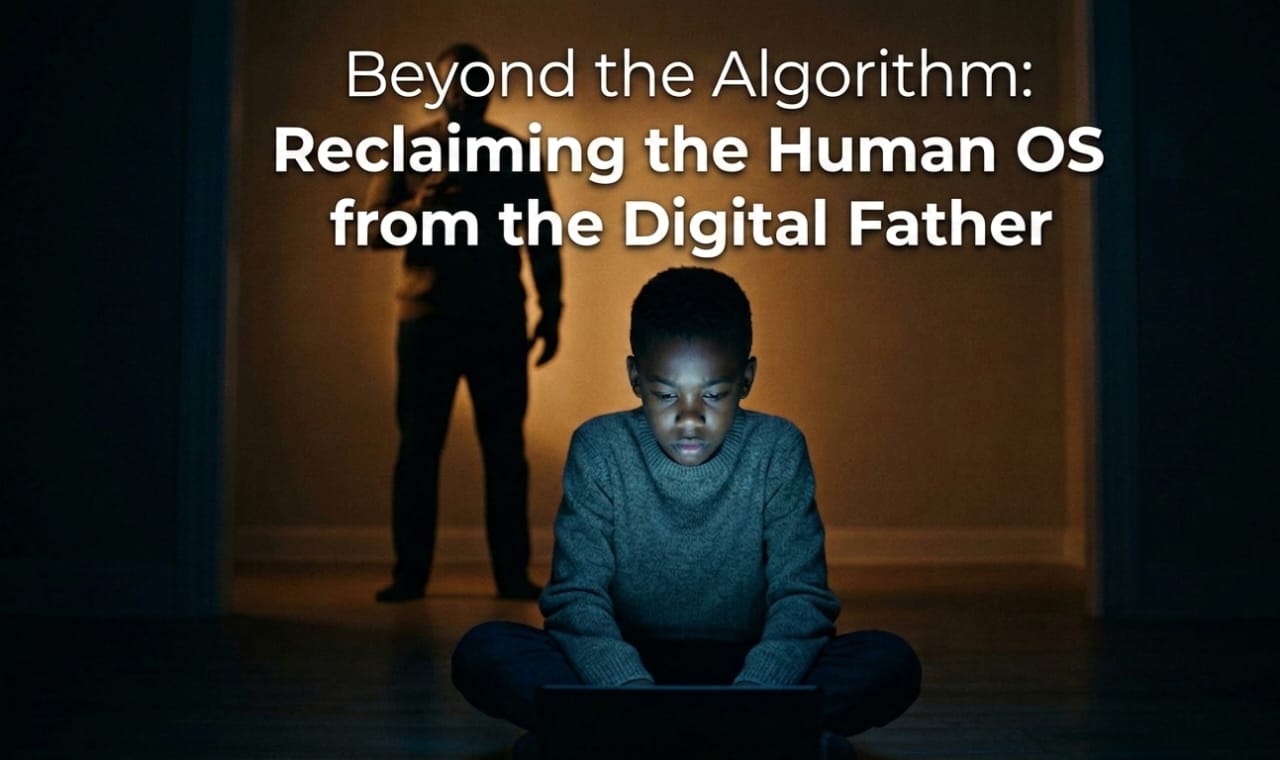
A transatlantic conversation on presence, performance, and what it will take to reclaim the formation of boys from the systems that will never know their names
By Ola Akinwe with insights from Jiri Rakosnik, Few Good Men (Amsterdam)
Boys Mentoring Advocacy Network (BMAN) | Global Boys Conversation Series
In the quiet vacuum of modern mentorship, a new architect of identity has emerged. It is always on, engagement-optimized, and globally pervasive. At BMAN, we call it the Digital Father — the algorithmic surrogate filling the space once occupied by present, purposeful men.
Boys are not growing up without guidance. They are growing up with constant guidance. The urgent, uncomfortable question is: who is doing the guiding? Today, many boys are not turning to fathers or mentors first. They are turning to search bars, to algorithms, to systems designed to keep them engaged — not developed, not guided, not seen.
“This is not just a technological shift. It is a developmental shift.”
— Ola Akinwe, BMAN
To explore how this digital script is reshaping the transition from boyhood to manhood, I sat down with Jiri Rakosnik, founder of FewGoodMen.co and a leading voice in the European Positive Masculinity movement. What emerged was not just a diagnosis of the problem — but the outline of a deeply human response.
THE VOID THE ALGORITHM FILLS
Jiri Rakosnik spent two decades in corporate marketing before his own identity crisis led him to Costa Rica, a shaman, and ultimately to founding Few Good Men. His journey is not incidental — it is the very evidence he brings to this conversation. He was, by every external measure, winning. And yet, something inside told him that what had brought him this far would not take him forward.
That internal fracture, he has since discovered, is not unique to him. His research across the Netherlands and Europe reveals that 61 percent of men who consider themselves successful also report feeling completely ungrounded — men living lives that do not feel like their own.
“61% of men claiming they are successful are also saying they feel completely ungrounded. They do not fully know who they are — and therefore it is difficult to be there for their own boys.”
— Jiri Rakosnik, Few Good Men
The consequences cascade directly onto the next generation. When fathers are disconnected from themselves, they have nothing grounded to pass on. Boys look around for living examples of integrated manhood and find absence — physical or emotional. And so, needing answers and finding none close by, they go where any curious, growing person goes: they go looking. Today, looking means going digital.
“The algorithm does not respect borders. What I see in Amsterdam is the same as what you are seeing globally. There is a void — and it is up to each of us how we fill it.”
— Jiri Rakosnik, Few Good Men
The Digital Father and the Crisis of Connection: Who Is Really Raising Our Boys in the Age of AI?
THE PERFORMANCE TRAP: MASKS MADE OF PIXELS
One of the most profound shifts in modern boyhood is the move from development to performance. Traditional masculinity was forged in real-world relationships — through challenge, accountability, and the steady presence of grounded men. The Digital Father rewards something entirely different: dominance, curated perfection, and the constant pursuit of digital validation.
“Do you think the Digital Father is pushing boys toward performing masculinity rather than developing it? And how does that show up later in men?”
— Ola Akinwe
Jiri’s answer is unflinching. The mask of performance boys adopt online does not disappear when they grow up. It evolves. The teenager performing for likes becomes the man performing for status — still disconnected, still running on the fear that who he truly is will never be enough.
“Men these days, even the younger ones, are obsessed with the mask. But they would call it optimizing.”
— Jiri Rakosnik, Few Good Men
The wound, Jiri explains, begins far earlier than the first smartphone. Between the ages of three and five, a boy who is naturally sensitive and relational is told — through mockery, through silence, through the withdrawal of approval — that those qualities are weakness. He stops being himself. He begins performing. He learns to become whoever will receive the applause. Over years, that performance becomes armor. And the armor eventually suffocates him.
“On one hand, you lose your sensitivity. On the other hand, you lose your essential power. And then you are left performing — putting on the heavy armor — until somewhere between 30 and 40, the energy simply runs out.”
— Jiri Rakosnik, Few Good Men
When boys are trained to seek likes rather than character, they lose the ability to strip away the pixels and find the actual person underneath. The Digital Father does not just shape what boys see. It shapes who they believe they are supposed to be.
The Algorithm is Raising Your Son: The Rise of the Digital Father
RELATIONAL RESISTANCE: THE DUTCH PERSPECTIVE
The Netherlands has long been a pioneer in social-emotional health. In our dialogue, Jiri and I examined what I call Relational Resistance — the critical ability for a boy to stay connected to himself and to others, despite the isolating pull of digital systems.
“How do we make the voice of a few good men louder and more attractive than the voice of a thousand algorithms?”
— Ola Akinwe
Jiri’s response reframes the question entirely. The answer is not to be louder. It is to be more grounded. The most magnetic presence in any room, he argues, is never the most reactive — it is the one who carries a deep, quiet calm. That groundedness stands out precisely because the algorithm cannot manufacture it.
“We are not trying to be louder. The most magnetic person in the room is the one who possesses a very grounded calmness. Because that person stands out.”
— Jiri Rakosnik, Few Good Men
Relational resistance is built through the nervous system — through breathwork, bodywork, and the slow, disciplined practice of staying present when everything inside pulls toward withdrawal. It is the fundamental mark of an integrated man: to remain connected when the tension rises. And crucially, it is what boys watch in the men around them. They are not waiting for a lecture. They are watching for proof.
THE RESPONSIBILITY OF PRESENCE
If the Digital Father is a symptom, the cure lies not in fighting the internet but in healing the men. Both Jiri and I return to the same foundational truth across every layer of this conversation: in order to guide anyone else, we must first do the work on ourselves.
“Boys are not waiting for another lecture. What they really want is someone who can be with them — physically, fully connected.”
— Jiri Rakosnik, Few Good Men
A father who has done his own inner work creates something visible and unmistakable at home: psychological safety. A space where a boy does not have to perform to be accepted. Where he can open up. Where a real conversation can finally happen. That environment — more than any content filter or screen time restriction — is what genuinely draws a boy back from the algorithm.
“The boys are actually proud. Suddenly they see that a dad can create an environment without self-judgment, very safe, where they can open up and together finally sit down and have a good conversation.”
— Jiri Rakosnik, Few Good Men
This is where BMAN and Few Good Men share a common mandate. Real mentorship is not a programme — it is a posture. It is the daily, consistent, intentional decision to show up: to be more present than the feed, more patient than the algorithm, and more genuinely invested in who a boy becomes than any system built for engagement could ever be.
“This is not just about technology. It is about presence, responsibility, and the future of how boys become men.”
— Ola Akinwe
THE 2026 MANDATE: UPGRADING THE HUMAN OS
As we prepare for the BFBC Global Summit on May 15, 2026, and the 2026 Global Communiqué, BMAN is advocating for a system-level response to the Digital Father. We call it the Human OS upgrade: the restoration of the internal compass that every boy already carries — but has been progressively taught not to trust.
Jiri calls it heart-led simplicity. It is, in his view, the single most important thing a mentor can offer a boy navigating the noise of the digital age.
“No algorithm, no internet wisdom is stronger than their own internal compass. Their body and heart already carry everything they need to know. Deep inside, there is a mechanism that already knows where you need to be and what you need to become.”
— Jiri Rakosnik, Few Good Men
Our mission is clear: while boys may use pixels for information, they must rely on presence for formation. The Digital Father is not waiting. It is already here, already patient, already consistent in ways that distracted, disconnected, or wounded men too often are not.
But here is what the algorithm will never possess: a name, a face, a history with a particular boy. The memory of who he was at seven, and the vision of who he could become at thirty. The ability to look him in the eye and say — I see you. I am proud of you. You are going to be okay.
“The algorithm can give answers. Only men and mentors can give future and direction to our young boys.”
— Ola Akinwe, BMAN
The Digital Father is already here. The question is no longer whether it exists — but whether the real ones are ready to show up.
About This Conversation
This article merges BMAN’s ongoing Digital Father series with insights drawn from a live global conversation between Ola Akinwe and Jiri Rakosnik, founder of Few Good Men (fewgoodmen.co), Amsterdam. It is part of the Global Boys Conversation Series leading into the Boys Future Boys Challenge Global Summit and 2026 Global Communiqué.

The statistic about 61% of successful men feeling ungrounded really hit home — it mirrors conversations I’ve had with friends who climbed the ladder only to ask “what now?” That internal fracture Jiri describes feels all too familiar in a culture obsessed with metrics over meaning.
That 61% statistic about successful men feeling ungrounded really hits home—it suggests how many of us are running on external validation rather than inner compass. The notion of the Digital Father as an algorithmic surrogate makes me wonder how much of my own early guidance came from search results instead of presence.
The statistic about 61% of successful men feeling ungrounded really resonates—it mirrors conversations I’ve had with friends who check every external box yet describe a quiet sense of drift. Makes you wonder how much the algorithm’s definition of “winning” has actually cost us internally.
The statistic about 61% of successful men feeling ungrounded hits home—it echoes what I’ve seen
That statistic about 61% of successful men feeling ungrounded really lands hard — it mirrors what I’ve seen in friends who seem to have everything together but admit they’re just going through the motions. The idea of reclaiming presence over performance is something we don’t talk about nearly enough in male spaces.